




Warning Signs You Need AC Repair Before Summer Ends
What we found inside failing late-summer ACs. Review these home maintenance tips and troubleshooting steps to decide if you need repair before fall arrives.
The Late-Summer Cooling Crisis: When Your System Runs Constantly But Doesn't Cool
The August back-to-school transition is stressful enough without your air conditioner suddenly giving up. If you are searching for home maintenance tips and troubleshooting advice because your cooling system is running non-stop but your house still feels warm and sticky, you are facing a classic late-summer cooling crisis. At Epic Air Heating and Cooling LLC, we see this specific pattern every August. By the time late summer arrives, your air conditioner has been working tirelessly for months, and that continuous strain often reveals hidden mechanical weaknesses. The decision you face now is critical: do you ignore the underperformance and hope the system survives until fall, or do you proactively diagnose the root cause before a total breakdown occurs?
This guide skips the basic reminders about changing your air filter. Instead, our team is looking closely at the serious performance symptoms we typically see emerging at the tail end of the cooling season in Commerce. Understanding how your system degrades after months of heavy use will help you make an informed decision about your home's comfort.
To get ahead of a failing system, explore our Air Conditioning Services for professional diagnostic support.
The Cumulative Toll of High Humidity on Your HVAC System
To understand why air conditioners struggle so much in late summer, you have to look beyond the thermostat reading. Air conditioning systems perform two distinct jobs simultaneously: sensible cooling and latent cooling. Sensible cooling is the process of lowering the actual temperature in the room. Latent cooling is the process of removing moisture from the air. Both require massive amounts of energy, but in our daily field work, we find that moisture removal is often the silent killer of HVAC efficiency.
Homeowners in Commerce, GA, experience extended periods of high relative humidity throughout the summer. This dense, moisture-heavy air forces your system to work twice as hard. Before the air conditioner can drop the temperature in your living room by a single degree, it must first extract gallons of water from the indoor air. This constant moisture extraction from May through August puts tremendous stress on your condensate drain line, the evaporator coil, and the compressor.
When an air conditioner begins to lose its efficiency, a loss of dehumidification is frequently the very first indicator. You might notice the house feels clammy, or your hardwood floors feel slightly tacky. If you are experiencing this loss of comfort, securing professional AC repair services is the safest way to prevent further equipment degradation.
Why Latent Heat Loads Cause Hidden Damage
The science of moisture: Latent heat load is the amount of energy required to remove moisture from the air. When your system struggles with a high latent heat load, it is forced to run in longer, continuous cycles.
The mechanical cost: These extended cycles prevent the compressor and blower motor from getting adequate rest. Over time, we frequently observe that continuous operation leads to premature motor fatigue, overheated electrical components, and accelerated wear on moving parts. The longer the system battles high humidity without relief, the higher the risk of a major component failure.
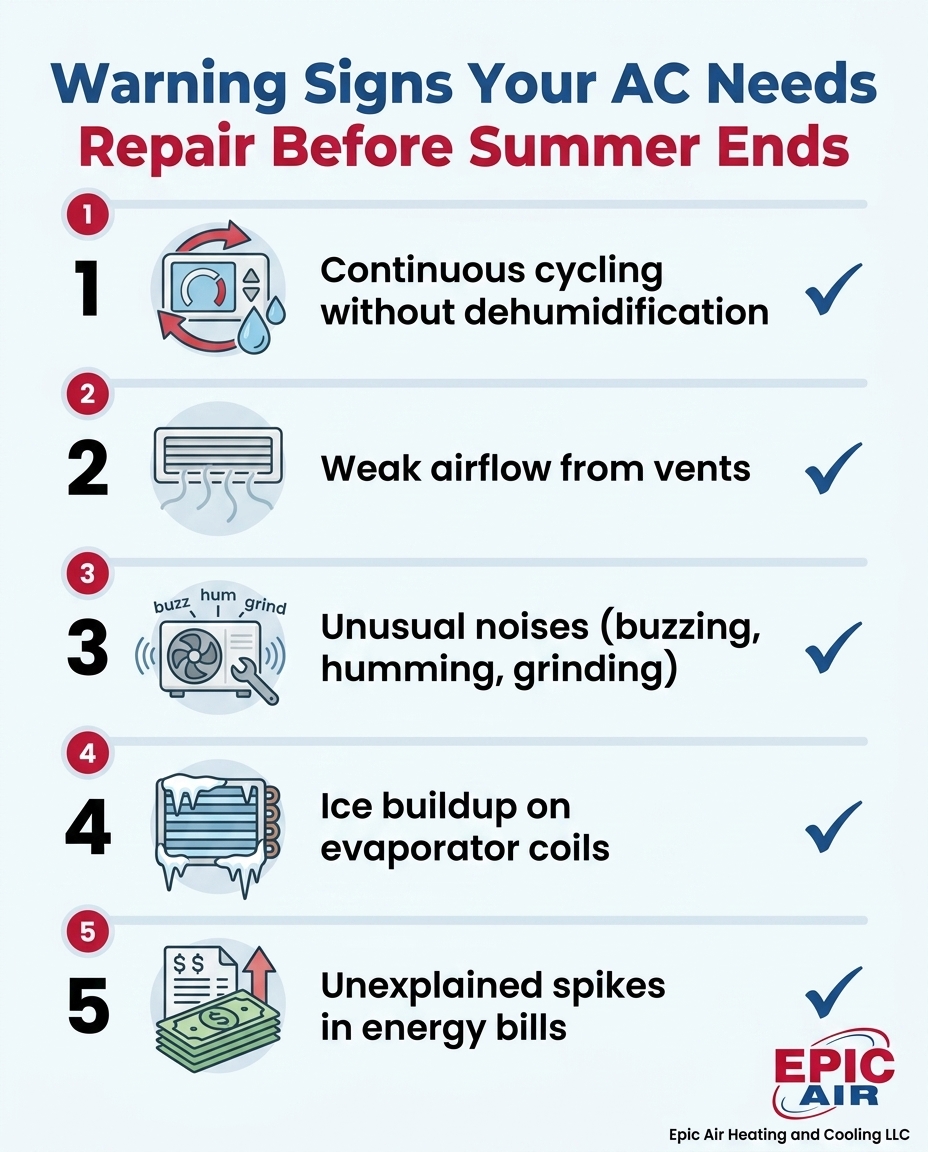
Warning Sign 1: Continuous Cycling Without Dehumidification
One of the most obvious signs that your air conditioner needs immediate attention is when the unit never turns off, yet the indoor air remains uncomfortable. You hear the system running constantly, but you still feel the need to run ceiling fans just to tolerate the indoor climate. This happens when the system completely loses its ability to extract latent heat effectively.
Common causes of continuous cycling include:
• Heavily soiled evaporator coils: Months of dust and debris buildup insulate the coil, preventing it from absorbing heat and moisture from the air.
• Failing electrical components: A weakened capacitor or struggling motor can reduce the compressor's efficiency, causing it to run constantly just to maintain a baseline temperature.
• Improper refrigerant pressure: Even a tiny leak that developed in June will result in a significant loss of cooling capacity by the time the August back-to-school transition arrives.
It is important to differentiate this symptom from normal operation. During an extreme peak heatwave, it is normal for an AC to run continuously during the hottest hours of the afternoon. However, if it runs constantly and the house still feels humid and clammy, the system is failing. Our team at Epic Air Heating and Cooling responded to a Commerce homeowner during a previous summer heatwave who experienced this exact scenario. Their air conditioner unit completely broke down after weeks of continuous running without dehumidifying the house. One of our technicians replaced the failing unit, corrected previous installation issues, and took the time to explain how the new system handles moisture more effectively. A comprehensive professional diagnostic is the only way to measure the exact cooling output and restore proper airflow.
Warning Sign 2: Weak Airflow and Straining Motors
Your blower motor is the heart of your home's air circulation. By late summer, it has pushed millions of cubic feet of air through your ductwork. To check its health, hold your hand over a supply vent and compare the air volume to what you remember feeling earlier in the summer. If the airflow feels weak, sluggish, or barely noticeable, you are looking at a serious warning sign.
Weak airflow typically indicates one of two major problems: a severely restricted air handler (often due to a clogged filter or dirty coil) or a failing blower motor. Motors rarely fail instantly; they usually die a slow, noisy death over several weeks. Listen closely to your indoor unit when it starts up. If you hear loud humming, aggressive buzzing, or a heavy grinding sound, the motor is struggling to overcome mechanical resistance.
Often, the culprit behind a straining motor is a degrading run capacitor. The capacitor acts as a battery that provides a jolt of energy to keep the motor spinning. When it weakens, the motor draws excess electrical current, overheats, and eventually burns out. Earlier this season, one of our technicians responded to a home where the HVAC system was not cooling properly due to exactly this type of weak airflow. Our tech diagnosed the issue quickly, replacing a burned-out motor and a failing capacitor to restore normal operation.
Never attempt DIY electrical repairs on an HVAC system. Replacing motors and capacitors requires handling high-voltage components and must be performed by a licensed professional. If you are noticing a drop in air volume, learning more about why your AC is not blowing cold air can help you understand the mechanics before our technician arrives.
Warning Sign 3: Frozen Evaporator Coils and Refrigerant Issues
It seems like a paradox: it is 95 degrees outside, yet a thick block of solid ice is forming on your indoor air conditioning components. A frozen evaporator coil is one of the most critical repair signs you can encounter during the hottest part of the year. When ice forms on the system, it means the heat transfer process has completely broken down.
The primary culprits behind a frozen coil:
• Severe airflow restriction: If warm indoor air cannot pass over the cold coil (due to a dead blower motor or a completely blocked filter), the coil's temperature drops below freezing, turning normal condensation into solid ice.
• Slow refrigerant leaks: A system low on refrigerant experiences a drop in pressure, which causes a corresponding drop in temperature. A leak that started small in May will often result in a frozen coil by late August.
Running a system with frozen coils is incredibly dangerous to the equipment. The ice acts as an insulator, and eventually, liquid refrigerant can flow backward into the compressor—a condition known as "slugging." Compressors are designed to pump gas, not liquid. Slugging will destroy the compressor's internal valves, turning a repairable issue into a mandatory system replacement. We saw the devastating consequences of this recently when a customer called our office about their elderly aunt's AC system, which had frozen over and stopped working. Our team diagnosed a severe underlying issue, and we ultimately had to install a reliable new system to keep her comfortable and safe.
The professional repair process for a frozen coil involves safely thawing the ice, thoroughly cleaning the coil surface, pinpointing the source of the airflow drop, and precisely measuring refrigerant levels to locate any leaks.
End-of-Season Fatigue vs. Critical Mechanical Failure
As summer drags on, many homeowners in Commerce, GA, call us wondering if their system is just tired or if it is actually breaking down. In our professional experience, it is important to distinguish between normal end-of-season fatigue and a critical mechanical failure that requires immediate intervention.
Normal late-summer fatigue usually looks like slightly longer run times during peak afternoon heat. The system might take an extra hour to reach your target temperature when it is 98 degrees outside, but it eventually recovers in the evening, and the house remains relatively dry and comfortable. Critical failure, on the other hand, involves a complete loss of cooling capacity, skyrocketing energy bills, and strange mechanical noises.
Hoping a struggling system survives until fall is a risky gamble. Delaying a professional evaluation often results in more expensive repairs later. To help you decide when to call our team, compare these common scenarios:
• Run Times — Normal Late-Summer Fatigue: Longer cycles during peak afternoon heat, but cycles eventually shut off. — Critical Mechanical Failure: System runs 24/7 without ever satisfying the thermostat setting.
• Humidity Control — Normal Late-Summer Fatigue: House feels slightly warmer in the afternoon, but humidity stays low. — Critical Mechanical Failure: Indoor air feels heavily clammy, sticky, and uncomfortable all day.
• Airflow & Sound — Normal Late-Summer Fatigue: Normal blower sound, steady airflow from all vents. — Critical Mechanical Failure: Weak airflow, accompanied by buzzing, humming, or grinding noises.
• Energy Bills — Normal Late-Summer Fatigue: Expected seasonal increase aligned with hotter weather. — Critical Mechanical Failure: Massive, unexplained spikes in energy usage compared to last August.
If your system falls into the right-hand column, scheduling professional AC repair in Commerce, GA with our crew is the best way to definitively diagnose the system's health before a total breakdown occurs.
What Happens When You Ignore Late-Summer HVAC Strain
Ignoring the warning signs of HVAC strain rarely ends well. Air conditioning systems operate on a domino effect: one failing part places excess stress on the next part in line. A degraded capacitor forces the blower motor to overheat. An overheating motor slows down airflow. Slow airflow causes the evaporator coil to freeze. A frozen coil sends liquid refrigerant back to the compressor, destroying the most expensive component in the entire system.
Beyond the mechanical damage, there is the sheer discomfort of a total system breakdown. The August back-to-school transition is a busy, stressful time for families. Coming home to a sweltering 85-degree house disrupts sleep schedules, ruins evening routines, and creates a miserable indoor environment. We always remind our customers that minor, early interventions—like replacing a capacitor or cleaning a heavily soiled coil—are always more cost-effective than emergency replacements.
When you rely on our team at Epic Air Heating and Cooling, you benefit from reliable, rapid response times during late-summer heatwaves, which is essential for preventing these total breakdowns. If our technician discovers that your system is suffering from catastrophic failure and is beyond repair, you may have options to offset the replacement cost. General energy rebates or federal tax credits may apply to qualifying high-efficiency upgrades. We always advise homeowners to verify current incentive programs with their utility provider or a tax professional to maximize their investment.
If you are already experiencing a complete loss of cooling, do not wait for the problem to worsen. Reach out to us for emergency AC repair immediately.
Frequently Asked Questions About Late-Summer AC Troubleshooting
Why is my AC running but not cooling the house?
If your AC is running but not cooling, the system is likely suffering from a severe airflow restriction, dirty evaporator coils, or low refrigerant levels. By late summer, months of accumulated dust can block the coil, preventing it from absorbing heat. Additionally, a slow refrigerant leak that started in spring will cause a complete loss of cooling capacity by August. A professional diagnostic is required to measure refrigerant pressure and clean the internal components.
How do you know if your AC is struggling?
You can tell your AC is struggling if it runs in endless cycles, fails to reduce indoor humidity, or produces weak airflow from the vents. You might also notice unusual sounds like buzzing or humming, which indicate electrical components are working too hard. Finally, if your late-summer energy bills are significantly higher than they were at the same time last year without a change in weather, your system is losing efficiency.
What are the signs your AC compressor is going bad?
Signs of a failing compressor include loud grinding or clanking noises, the system tripping your circuit breaker repeatedly, or the outdoor unit shaking violently on startup. The compressor is the heart of the system, and when it struggles, you will also notice a dramatic drop in cooling power. Because the compressor is a sealed, high-voltage component, these signs warrant an immediate professional inspection.
When should I call for AC repair?
We recommend calling for AC repair as soon as you notice continuous cycling without comfort, ice forming on any part of the indoor or outdoor unit, or strange mechanical noises. Waiting for the system to break down completely often turns a minor electrical fix into a major compressor failure. Proactive repair protects your equipment from the cumulative wear and tear of the long summer season.
Why is my house so humid even when the AC is running?
High indoor humidity despite a running AC usually means the system is failing to perform latent cooling. This happens when the evaporator coil is too dirty to condense moisture, or when the system is short-cycling (turning on and off too quickly to extract humidity). It can also occur if your air conditioner is oversized for your home, causing it to cool the air rapidly without running long enough to dehumidify it.
Can a dirty evaporator coil cause my AC to run continuously?
Yes, a dirty evaporator coil acts as an insulating blanket, severely restricting the system's ability to absorb heat from your indoor air. Because the system cannot reach the temperature set on your thermostat, it will run continuously in a futile attempt to cool the house. Cleaning the coil restores heat transfer and allows the system to cycle normally again.
Don't Wait for Fall: Address AC Performance Issues Today
Understanding why air conditioners lose efficiency by late summer empowers you to make smart maintenance decisions for your home. The cumulative toll of running continuously against high humidity means that minor issues we see in May can turn into major failures by August. Spotting specific warning signs—like continuous cycling, weak airflow, and frozen coils—warrants a professional diagnostic from Epic Air Heating and Cooling rather than ignoring the problem and hoping the system survives until the weather cools down.
A clear explanation of your system's health and the specific signs of mechanical fatigue can save you from a costly breakdown during the busiest time of the year. Do not let an underperforming system disrupt your comfort. Explore your local AC repair options with our team today to restore your home's cooling power and humidity control before the season ends.


Financing
Our financing solutions are designed to meet your unique needs, offering flexibility and support for your financial goals.


Financing
Hearth Financing helps make your HVAC upgrades more affordable with personalized payment plans and flexible options.
Customer Testimonials
Our customers consistently praise our exceptional service and attention to detail, making us a trusted choice for all your HVAC needs.


We highly recommend this company. We have used other larger hvac companies in the past that have led to a lot of frustration. Epic Air has been fantastic on all levels especially attention to detail and customer service. We are very thankful for David and will use Epic Air for all of our heating and cooling needs. Great company highly recommend.

Epic Air has been thorough and fair with us on multiple projects, at two of our properties great communication and honest with us, never have been pushy at upselling us on what we didn’t need. From maintenance, service to full replacement, If your in the lake Lanier area or north Georgia I highly recommend.
5 stars! I really enjoyed my experience. They were on time, communicated the issues very well, and made me feel at ease. They even sent me a follow up email with before and after photos. Amazing service - will recommend to everyone!
EPIC Air Heating and Cooling provided us with prompt and exceptional service replacing our A/C unit.The two repairmen went above and beyond to service our needs. They were prompt, honest, extremely knowledgeable, and they completed everything in a timely manner.I highly recommend this business!
Epic Air Heating and Cooling is the way to go! They were very responsive and quickly dispatched someone to my home. Zach was amazing. He was in and out! Within minutes he discovered problem and resolved it. I am grateful for the service provided. Thank you again!
Thank you to David! My air conditioning unit has not worked for almost 2 months and David from Epic Air was here less than an hour and had my system running. I appreciate the support and service and would use you all in the future. Thank you again.

